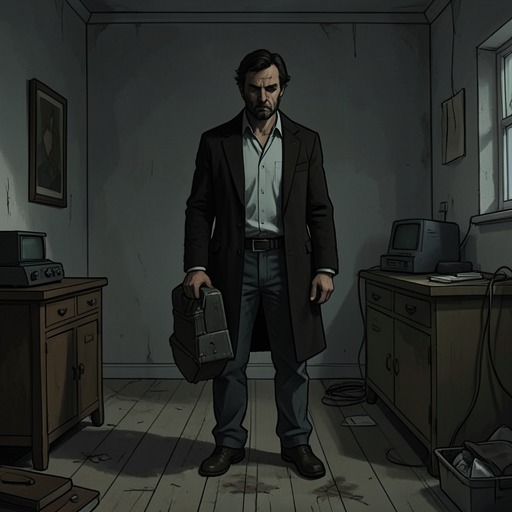
Vincent Radebe’s written admission
Heart of the HunterVincent Radebe’s written admission is a formal statement of responsibility whose significance extends beyond accepting a charge: it records how negligence and unauthorized action caused harm, while exposing Radebe’s growing distrust of the operation he had served. Read to a committee, the document joins an account of events to an attempt at moral reckoning. Radebe acknowledges what he did, names the consequences, and explains why his former faith in the Presidential Intelligence Unit no longer holds.
Formal Status and Occasion
At the committee hearing, Radebe waives his right to representation and is asked under Article 15 (1) to prepare a written admission or rejection of the charge. He confirms that he composed the document of his own free will, then reads it aloud at the chairman’s request. These procedural details establish the statement as Radebe’s own account rather than an account merely attributed to him by others. Afterward, he agrees that it be recorded as his written admission of the charge. The document thus moves through a defined sequence: preparation, voluntary confirmation, public reading, and formal acceptance into the committee’s record.
That sequence gives the statement a double function. It is a procedural act that accepts responsibility in an official setting, but it is also a personal explanation addressed to the committee. Radebe does not limit himself to acknowledging that his conduct hindered and complicated an official operation. He identifies particular actions, traces their consequences, and sets out the principles and misjudgments through which he now understands them. Its formal status makes the account consequential; its first-person self-assessment makes clear that the consequences are not merely administrative for him.
Admissions and Their Consequences
Radebe directly connects his negligence to Miriam Nzululwazi’s death on 26 October. He admits that he failed to lock the interview-room door. As he describes the chain of events, Miriam left the room without an escort while in a disturbed state of mind, and then fell to her death from the building’s fire escape. He accepts responsibility for the death, calling his negligence its direct cause. The statement therefore specifies both the concrete failure—a door left unlocked—and the fatal consequence, rather than leaving his admission at the level of general regret.
The document records a second, distinct admission from the same day. Radebe says that he unlawfully abducted Miriam’s six-year-old son, Pakamile, without official sanction and kept him at his home overnight. On 27 October, he handed the boy to personnel of the Cape Times. He recognizes that doing so undermined the Presidential Intelligence Unit’s operation. The statement places these actions beside one another without treating them as interchangeable: one concerns the circumstances leading to Miriam’s fatal fall; the other concerns taking and then transferring her child outside official authority.
Radebe also declares that he acted alone in both instances and wishes neither to blame nor implicate anyone else. This is a bounded claim about the two acts he has just described. Within the document, it concentrates responsibility on the speaker himself, while his separate acknowledgment that the incidents hindered the operation identifies an institutional consequence as well as personal wrongdoing.
A Career Reconsidered
The mitigating account begins with Radebe’s reasons for entering intelligence work. After completing his studies at the University of the Witwatersrand, he says, he genuinely wanted to contribute positively to the country. He recalls being inspired, like many of his compatriots, by Nelson Mandela’s forgiving and positive vision, and says he wished to dedicate his life to building the Rainbow nation ideal. In his earlier understanding, the Presidential Intelligence Unit offered a way to serve that purpose. The statement therefore presents his choice of career not as a confessed scheme for personal advantage, but as a commitment whose original public-minded rationale he now finds inadequate to justify what followed.
Radebe concedes that passion and dedication can fail: zeal, he says, may blind a person to personal faults and shortcomings. He accepts that protecting the state and democracy can demand difficult decisions from public officeholders and that ordinary, innocent civilians may be negatively affected by them. Yet he cannot make that general account settle the particular case. He says the events of 26, 27, and 28 October were traumatic, and that he was deeply disturbed by what he considered infringements of the basic human rights of Thobela Mpayipheli and, later, Miriam. Even allowing that the operation’s purpose might have been important to national security, he says he could not grasp how its purpose justified its means.
Responsibility, Regret, and the Document’s Limits
Radebe identifies his own failure not only as negligence but as a failure of judgment in response to his dismay. He says he should have been diligent rather than negligent, regrets his part in Miriam’s death, and singles out his failure to make a stronger stand or protest more vigorously through official channels. His account gives his remorse a specific institutional dimension: he faults himself for doubting his own judgment of right and wrong when he believed the operation violated basic rights. His promise that this will not happen again follows from that admission, though the document records the assurance rather than any later proof of its fulfillment.
As a piece of self-account, the statement holds two positions in tension. Radebe recognizes that state protection and democracy can involve difficult choices, yet cannot reconcile that rationale with the treatment of particular civilians. He accepts that his actions damaged an official operation, but also describes the rights infringements within it as the source of his dismay. The written admission does not resolve that conflict or establish an outcome for the committee’s proceedings. It fixes Radebe’s acceptance of the charge and preserves his account of the failures, the harm, and the ethical doubt he says he should have acted upon sooner.